
The secrets of your blood
The color, texture, and amount of blood you shed can tell you more about your health than you ever imagined. Always remember: your period is a vital sign, just like blood pressure, and pulse rate. Leaving it out of the equation can mean ignoring one of the clearest symptoms your body is able to express to you.
Color
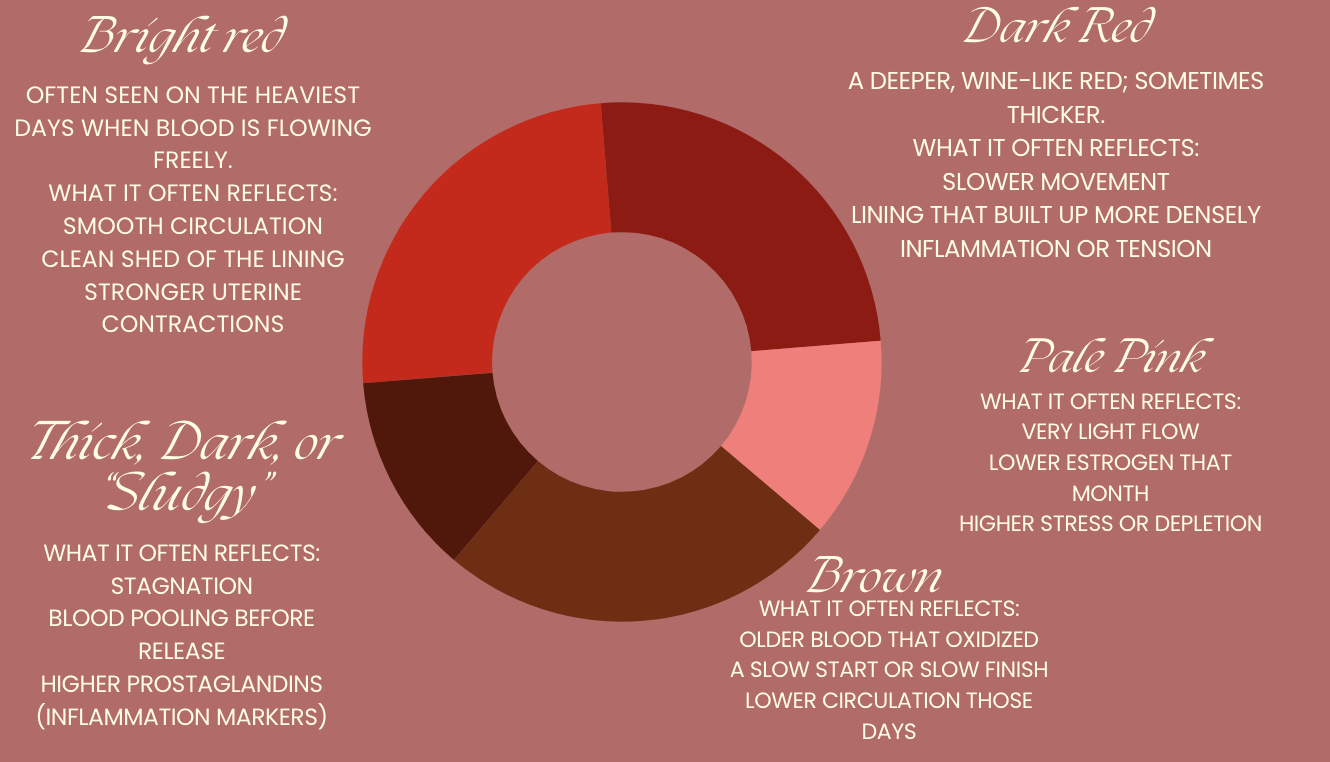
Ask yourself:
What color do I start with?
Is my heaviest day always bright red?
Does pink or watery bleeding show up during stressful months?
Do dark, thick days always coincide with cramps?
Is my pattern the same most months, or constantly shifting?
Consistently bleeding a light pink color then stopping is a sign of depletion. Brown is indicative of an unfinished cycle, or shedding an old lining, which can mean that your prostaglandin count is high.
Every single color of your blood is a message from your body.
Typically, a balanced cycle will begin bright red, and end a deep red.
Flow & Texture
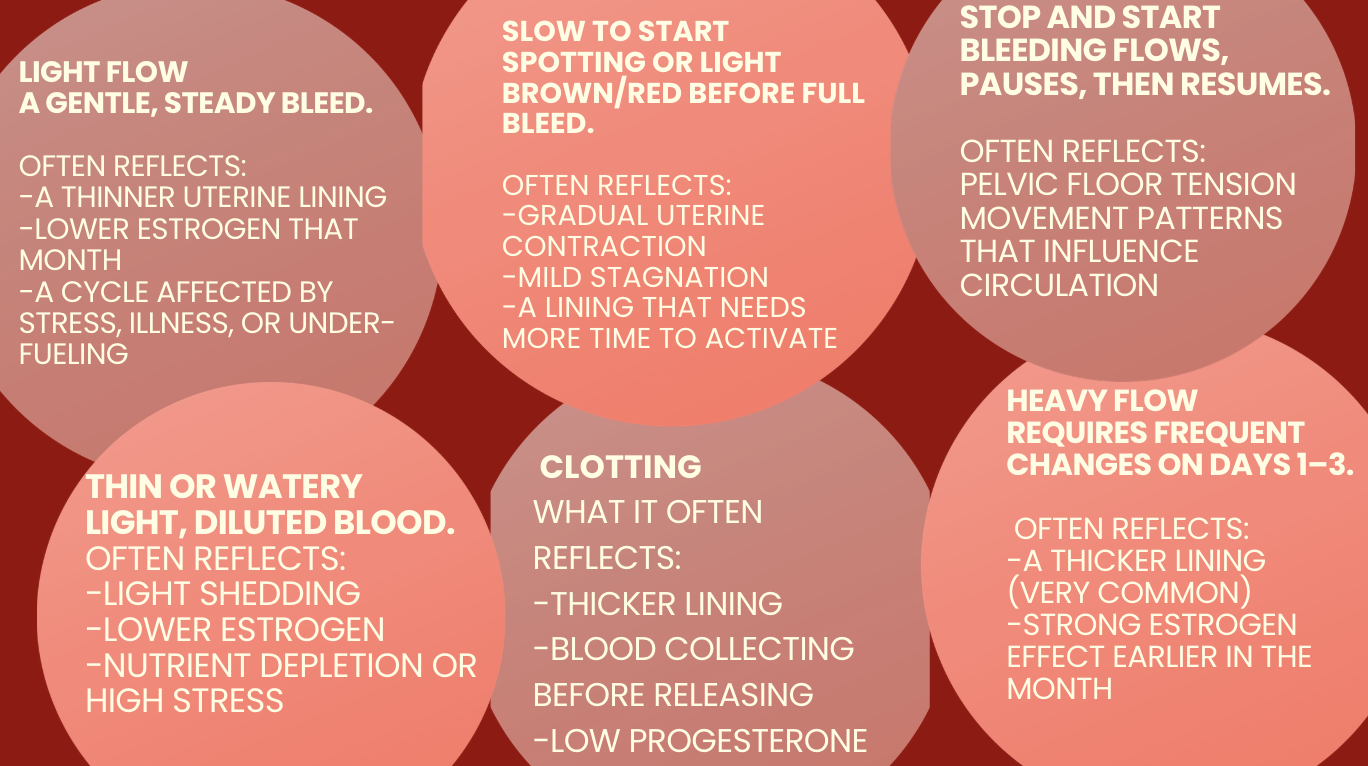
Ask yourself:
Is my flow consistently very light?
Does my bleed always start slow and then become heavy?
Do I always get clots on the first heavy day?
Does stress always make my flow thinner or longer?
Does movement or warmth shift my flow pattern?
Clotting is typically indicative of excess estrogen, but it can also be due to thyroid malfunction.
Spotting and Timing
Spotting Before Your Period
Light brown or red spotting 1–3 days before your bleed.
Often reflects:
Progesterone beginning to drop
The lining starting to loosen
A slower “activation” into the period
Pay attention if:
Spotting lasts several days before your real bleed.
That tells you the transition from luteal to menstrual was slower that month.
Spotting After Your Period
Brown or pink discharge once you think the bleed is done.
Often reflects:
Residual old blood
A slightly uneven shed
Lining releasing in two parts
Pay attention if:
You regularly have a “second tiny bleed” a day or two later.
This shows the body needed more time to fully release.
Mid-cycle Spotting
Light pink or red spotting right as cervical fluid peaks.
Often reflects:
A sharp estrogen rise
The ovulatory phase being more pronounced
Cervical tissue becoming more vascular
Random spotting
Spotting that doesn’t match ovulation, early bleed, or late bleed.
Often reflects:
Your lining responding to stress or sudden hormone dips
Sleep disruption
Travel, illness, or rapid routine changes
Transition after intense exercise